Showing posts with label George B. Schaller. Show all posts

Wednesday, October 26, 2011

Thinking About Endangered Animals


I’m packing and otherwise getting ready to go to the 2011 meeting of the AASL in Minneapolis tomorrow and, since I’ll be talking about the chiru, I thought it might be appropriate to interrupt the discussion on beginnings to share a sampling of books about other animals who, like the chiru, are or have teetered on the edge of existence.

Ellis, Carol. Apes Endangered. Benchmark, 2010. (One of a series of books on endangered animals).

Firestone, Mary. Top 50 Reasons to Care About Elephants. Enslow, 2010.

Kurlansky, Mark. World Without Fish. Workman, 2011.

Lasky, Kathryn. Interrupted Journey: Saving Endangered Sea Turtles. Candlewick, 2006.

Montaigne, Fen. Fraser’s Penguins: A Journey to the Future in Antarctica. Henry Holt 2010. (for teens and adults).

Montgomery, Sy. Spell of the Tiger: The Man-eaters of the Sundarbans, Houghton Mifflin, 1995.

_____________. Kakapo Rescue: Saving the World’s Strangest Parrot. (illustrated by Nic Bishop). Houghton Mifflin, 2010. Siebert Medal Winner 2011.

Safina, Carl. Voyage of the Turtle: In Pursuit of the Earth’s Last Dinosaur. Holt (paper) 2007.

Sinha, Vivek, R. The Vanishing Wild Tigers: Co-Predator and Prey Species. Anova, 2003. (for all ages).

Turner, Pamela S. A Life in the Wild: George Schaller’s Struggle to Save the Last Great Beasts. Farrar Straus & Giroux.

Only by understanding the peril can we act to prevent it. I hope this list will be a useful beginning for some readers.


Tuesday, April 26, 2011

Living Room Tourist: Lhasa


The story and setting of The Chiru of High Tibet may make readers want more information about Tibet. Who wouldn't want to travel to such a beautiful and mysterious land? But real travel to Tibet is expensive and arduous. Still, there's the possibility of "living room" travel, traveling by immersing ourselves in the pictures of and writing about a place. Of course there are many places to go for pictures and writing about Tibet. Here are a couple of my favorites:
Galen Rowell and the Dalai Lama worked together on a wonderful book called My Tibet (University of California Press, 1995). The photographs are by Galen Rowell, who was one of the trekkers in The Chiru of High Tibet. The text is by the Dalai Lama.

George B. Schaller made many trips to Tibet to study the animals who live there. George Schaller is also a wonderful photographer and his book Tibet's Hidden Wilderness (Harry Abrams, 1997), which focuses on the animals and the people of the Chang Tang plateau will whet any reader's appetite for more Tibet.


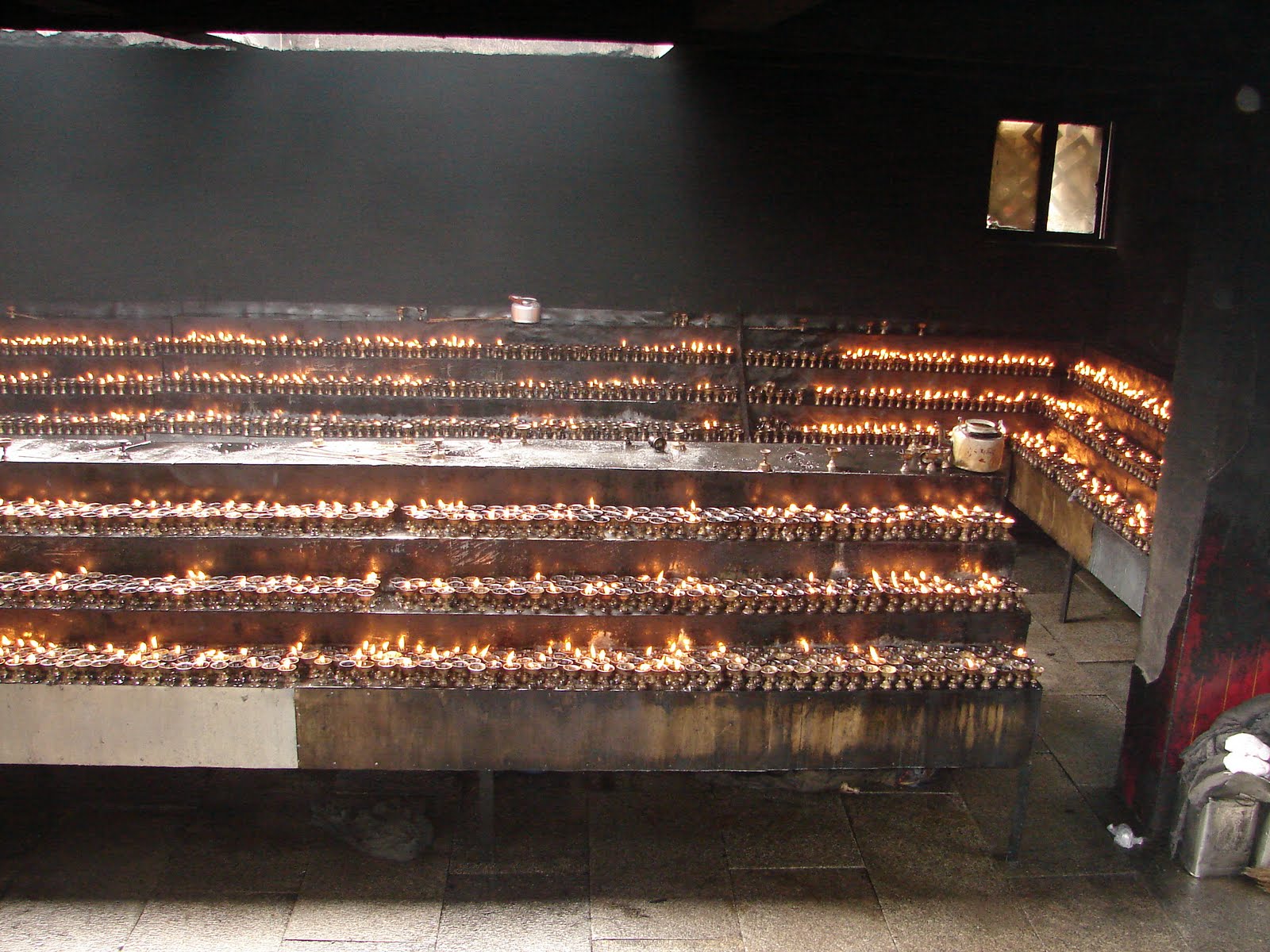
As the anniversary of my May/June trip to Tibet a few years ago gets closer I have the urge to revisit some of the places I feel as if I only glanced at. I would certainly spend more time at the Jokhang Temple in Lhasa, where I took these photos. It is the most sacred temple in Tibet. The goal of every Tibetan Buddhist is to go to Lhasa and go around the Jokhang. Some walk. Some prostrate themselves all the way around, that is, spread their bodies out flat along the ground, then scoot forward toward their hands, stand up and then spread flat again, a slow and painful way to travel, but a way that religious pilgrims believe expresses their devotion to Buddha.

The temple, though much changed over the centuries, has been on this same spot since the 7th century. King Songtsen Gampo built it to be a place for an image of Buddha brought to him by one of his queens.

Current visitors enter an open courtyard (pictured at the top of this entry). If we turn right and go under the balcony, we'll see a table filled with yak butter lamps (also above). We'd enter the temple itself off this courtyard. And we'd be able to stroll past many chapels of statuary and paintings of Buddhas other important figures in Tibetan Buddhism.

At some point we'd be ready for tea. Here's a recipe for tea that is similar to Tibetan yak butter tea:
(serves 1)
1 cup boiling water
1 tea bag (black tea)
steep tea bag in water for several minutes, then put tea in a blender or heavy jar with 1 tsp. butter and a couple of shakes of salt. Blend or shake for about half a minute. Pour into a cup or glass. Drink and think of far off mountains.

Friday, November 12, 2010

Bringing Tibet to the classroom, bringing the classroom to Tibet


Good news for The Chiru of High Tibet!

The National Science Teachers Association--Children's Book Council's Outstanding Science Committee has named the book to the "Outstanding Science Trade Books for Students K-12" List for 2011.

I hope that teachers who work with students of all ages will want to use this book.. I plan, over time, to share books in several curriculum content areas that relate to The Chiru of High Tibet--endangered species, the environment, cultural studies.

I'm starting today with some books and stories that are set in Tibet or, as in the case of the George Schaller biography and Rick Ridgeway's book, are directly connected to The Chiru of High Tibet.


Picture Books

Berger, Barbara Helen. All the Way to Lhasa. Philomel, 2002. A telling of a Tibetan tale by the author of the wonderful Grandfather Twilight.

Gerstein, Mordecai. Mountains of Tibet. HarperCollins, 1989. Story of a Tibetan wood-cutter who loves to fly kites and is given a chance to live his life again.

Sis, Peter. Tibet Through the Red Box Farrar, Straus & Giroux, 1998. I loved this book before I even knew about the chiru. It's part autobiography, part folk tale, part journal. And of course includes Sis's wonderful art.

Soros, Barbara. Tenzin's Deer. (illustrated by Danuta Mayer) Barefoot Books, 2005. Tenzin discovers a wounded deer in the mountains and nurses it back to health.

Turner, Pamela S. A Life in the Wild: George Schaller's Struggle to Save the Last Great Beasts.
Farrar, Straus & Giroux, 2008.

Chapter Books

Dalai Lama (author) and Galen Rowell (photographer). My Tibet. University of California Press, 1995. The trek following the chiru told in The Chiru of High Tibet was not Galen Rowell's first trip to Tibet. In the 1990s he had taken stunning photographs of Tibet for this book. This is a wonderful book that can be enjoyed by anyone who wants to see more of Tibet and/or hear the voice of the Dalai Lama.

Rick Ridgeway. The Big Open. Rick Ridgeway's own telling of the trek following the chiru, along with a history of the trade in chiru skins and extensive details of the efforts by Tibetans and others to put an end to this trade. Rick Ridgeway is a wonderful writer and this is a good, accessible read for middle schoolers or older.

Tenberken, Sabriye. My Path Leads to Tibet. Arcade, 2004. Very accessible and gripping story of a young blind woman from Germany who decides to go to Tibet and establish a school for the blind children of Tibet. In Tibet blindness is sometimes considered a curse from the spirits. So blind children were often treated poorly, not allowed to leave home, forced to do the most menial work. This book takes readers to Tibet to watch as Tenberken works toward her goal and reminds us that one person can make a difference.

Books, plus barley crackers, hot tea with a bit of butter and a shake of salt take us almost to Tibet. Good travels!

Friday, September 17, 2010

Saving and keeping


Last weekend we made a road trip to Decorah to walk the grounds and look at the gardens at Seed Savers Exchange. Seed Savers Exchange is devoted to saving the seeds of heirloom vegetables. According to their website, "Their collection started when Diane Ott Whealy's terminally-ill grandfather gave them the seeds of two garden plants, Grandpa Ott's Morning Glory and German Pink Tomato, that his parents brought from Bavaria when they immigrated to St. Lucas, Iowa in the 1870s."

The Whealys decided to develop a repository of seeds that individuals had saved for generations. Most seed companies had narrowed their offerings to only a few varieties and the couple was worried that crop diversity would soon be lost. Seed Savers has thousands of varieties of vegetable seeds now and has also expanded from that original mission to establish a herd of White Park cattle, some poultry, and an orchard of heritage apple trees.

As we walked the grounds and looked at the once endangered White Park Cattle and the beans and squash, tomatoes, corn, and other vegetables and flowers grown from seeds carefully tended, saved in envelopes and jars, I began to think about saving, keeping intact.

Of course "saving" reminded me of George Schaller's, Rick Ridgeway's and others' efforts to save the chiru. We have an urge to wholeness, to keep our world whole, to go against the current of loss and destruction that seems so frequent a part of modern life.

In the middle of the woods at Seed Savers I began to dream up some discussion questions for kids. Questions about losing things. What have they lost? What have I lost that I regret losing? A book of poems that my daughter Sarah wrote and made and gave to me. (She only made three and I lost one. I feel its loss often); one of a pair of hand knit mittens made by a friend no longer living, an old six quart kettle that my mother used to pick raspberries.

And I thought I would like to try doing some writing with students about losing and saving. Could we write something about those lost things? What they stand for? Why we remember that we lost them? Can we think of anything we have saved from being lost or tossed? An old toy? A cherished piece of furniture?

Sometimes what is lost gets found. And those are the happy occasions. Things are looking up for the chiru. A recent note from George Schaller tells me "chiru are now on the increase." But sometimes lost is lost--like passenger pigeons. Perhaps that's why saving feels so good.

Thursday, August 12, 2010

Speaking about voice, writing voice


Maisie

What are these dogs doing on a blog about writing and chiru and endangered species?

All will be revealed. And it's all related to writing and chiru.


Today's writers of non-fiction use many of the tools of fiction to make their stories compelling and accessible to readers. One of the strongest tools we have is voice. If we can find a quote from a real character, if we can let our real characters "speak" in our books, these characters become more alive and more interesting to readers. That's why I was so pleased when my research revealed the quote from Wilson Bentley, which in some ways came to symbolize his life for me: "I can't afford to miss a single snowstorm. I never know when I will find some wonderful surprise." Bentley didn't say that because he was getting rich from his snow crystal photographs. He regularly spent more than he took in. It was his personal account book, his "beauty in the world" account book that he needed to keep a balance in. And the quote, the voice, told us that.

When writing the chiru story, I wanted to give voice to the people who worked to rescue the chiru. I wanted readers to hear the desperation in George Schaller's voice when he said, "Wearing a shahtoosh shawl is the same as wearing three to five dead chiru."

Voice sets one character apart from another, helps us to distinguish and remember characters. For example, I am visiting my sister Laura and her husband Bruce these days. Laura and Bruce have a dog Izzie. Izzie has a couple of friends--Geordie and Maisie. They are all Border Terriers. But they are so different. Geordie (top) is a worrier. Izzie (bottom) is exuberent and always hungry. Maisie (middle) is alert for the chance to do the work of terriers (she has had several unhappy encounters with skunks).

If I were writing about these dogs, of course I would write about how each spends a morning: Geordie, watching from someone's lap--and worrying; Izzie prowling the kitchen floor for scraps and wildly greeting all who come to the door; and Maisie chasing squirrels outside. And I would give them a voice:
Geordie: Is everything going to be ok? Can you be sure?
Izzie: Yum, yum, raw carrots. I'll be your friend, friend friend.
Maisie: The squirrel ran around a tree and I ran around a tree then the squirrel ran across the back yard and I followed and we were both running, running I was barking barking barking and then the squirrel ran up the tree. Next time, I know I know I'll get that squirrel.

A good exercise for students, or any of us who want to write better, is to find a few photos of distinctly different characters--people or other animals--and invent a voice for each. What would each be worried about? What kinds of words would they use, big words, little words, verbs, lots of flowery adjectives? Would they repeat certain words? Ask a lot of questions? I have had the experience many times of finding a story when I found the voice of one of the important characters.

Playing with voice is useful for non-fiction writers, too, even though we can't invent a voice for a real character (unless we speculate based on the best information we have and say "maybe she said...." or "He might have said..." ).

The more we know about voice, voices and what they convey,the better able we are to choose the quotes from our research into a character that will help us to tell his or her story.

(dog portraits by my friend, Liz Wiesen, co-parent, with my brother David, to Geordie and Maisie)