Showing posts with label The Chiru of High Tibet. Show all posts

Friday, September 14, 2012

Saving Seeds, Growing Seeds

Ok, so this is the gorgeous tomato once again.

It seemed too perfect to let go, so I did the whole thing--saved the seeds and the juice around the seeds, put it all in a jar with water and let it sit while Rich and I went to Des Moines. The notion is that the liquid will ferment and the fermentation will break down the coating that prevents the seeds from sprouting inside the tomato. Some of the seeds were so eager to grow that they sprouted while we were gone, but not all.

When I look at these tiny seeds about the size of an "o,"
and think that a tomato plant that can cover my 12'x12' garden and enough tomatoes to make BLTs for weeks for Rich and me and all our neighbors, I am astonished--all of that from one tiny, sort of furry, seed.

I am eager to plant these seeds next summer and see what grows.

But in the meantime, I'm thinking of seeds, saving seeds, stories, seeds of stories. The idea for Charlotte's Web was partly due to a sick pig. I think Lois Lowry's The Giver began with the seed of a family member with a failing memory.  

The Chiru of High Tibet began with the seed of a radio program and grew into a trip to Tibet, a book, a blog.

While we were in DesMoines we went out for a stroll. Of course we had to walk along the river.

But there was also the mystery of the blue shoes, next to a garbage can, just off Locust Street.


Who took them off?  What were they traded for? And why? They aren't worn out.  I want to know about their owner. Did she buy them on a whim at one of the second hand stores on Locust Street? Did someone buy them for her? Was it a kid, a ten year old who wanted to be grown up, but actually hated the clompy feel of those shoes?  These are more than just shoes.  They are seeds. Seeds for someone to grow a story. Help yourself.

Thursday, June 14, 2012

Journeying


I have lost a few days in this return from the Chang Tang. But perhaps it's to be expected that the present will keep interfering. Yesterday I had to go on a picnic with friends to a patch of native Iowa prairie, that is still virgin prairie because it was designated as a cemetery in the middle of the nineteenth century.

But I do want to finish this journey out of the Chang Tang and back to Iowa. It feels as if I need to complete the circle of the journey in order to truly be back in the present.

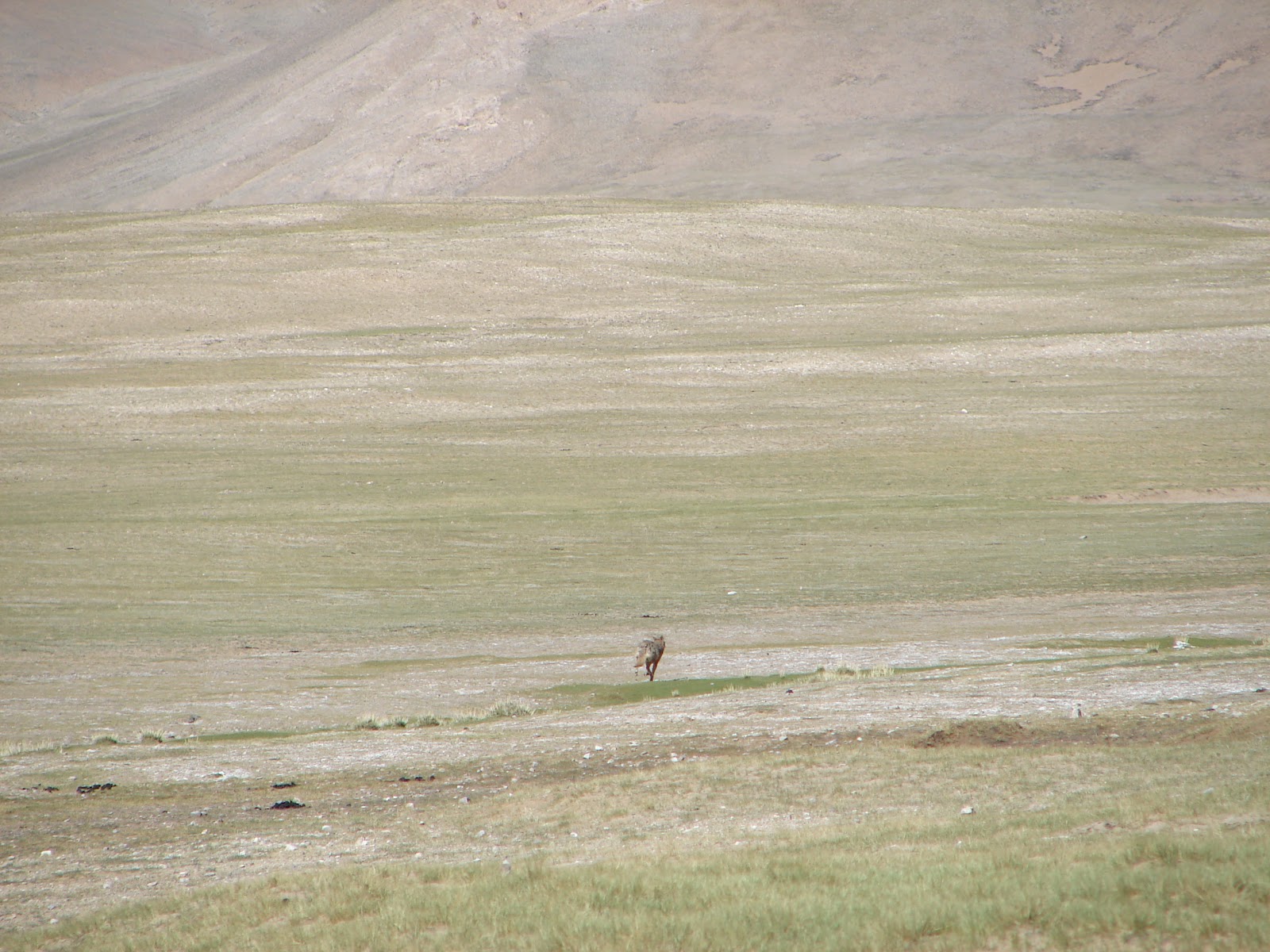
wolf--and plains

June 7, Day 21, Wednesday 7:05 p.m. Beijing time  (elev. 5400 meters)


We drove 585 km today from Gertze to a small town called Raza. Three hundred and sixty three miles. I doesn't sound like too much but the roads are all dirt roads and fairly rough in most places. I am really tired. Part of that may be that I put on a patch for carsickness and they make a person drowsy.


I find as we come back across Tibet there are certain swatches that I just don't remember, like camping by the river. [I must have been drowsy on the way out, too.]


Tormorrow we get to Shigatse. Jinpa says that's the second largest city in Tibet. I can buy souvenirs, maybe do some email, maybe wash some clothes. We'll be in Shigatse until Saturday morning when we go to Lhasa. I think Jinpa and Mr. Lee will be glad to deposit us at the airport hotel and head home to their families. It will have been three weeks.


Coming east today we saw quite a number of gazelles, and kiang, one wolf, a couple of chiru and two dogs having a  doggy conference in the middle of the wilderness. It was like they had made an arrangement--"ok, let's meet 100 miles east of Gertze, just off the main road at 10:45."


Heinrich kept tract of all the animals we saw and where on the map we saw them. He'll have a really complete record when he gets home.


Jinpa told us of the time at age 18 he and his cousin biked on old Chinese bikes from Lhasa to Mt. Kailash. They did the pilgrimage and he went to India to learn English. They slept on the ground.


I also wanted to mention that when we were at lunch today a man was standing outside the window, obviously wanting some food. I sat there and wondered what to do. Heinrich made arrangements with Jinpa for the waitress to give the man our leftovers. A kind gesture.


This motel room [I am in, writing] has 4 beds, a table, 2 bowls and a bucket. The bucket can only be  for one thing since the loo is a side hill behind the other building.


I find that as we make the drive to leave Tibet that I'm astonished that I actually came here. I hope with the words and the pictures I've recorded enough that I'll remember the trip [and come to understand the experience more fully].


9:00 p.m. Jinpa told us tonight he makes 2000 yuan a month--good for Lhasa he said. And he's been guiding for 10 years. I think he must be about Justin's age. Our kids would like him.

Yesterday I went to a small remnant of what Iowa used to look like. We have one-tenth of one percent of native prairie left in this state. In Tibet I was seeing native land as it had evolved, hardly touched by man or machine. We have so few places like that, that the trip was not only a giant step away geographically, but also a step back in time.  I wonder what changes the high speed rail and the discovery of minerals have wrought on this place.

Thursday, May 31, 2012

On the road to a new campsite

May 30, 2006--Day 13


On the road to the new campsite


The Aru Basin is so quiet this morning a frying egg sounds like an explosion; the whirr of crows flying is sound enough to fill our space and a tent zipper is a loud statement of human activity. We have few places in the US of such quiet. It's cloudy here this morning. We can't see the peaks of all the mountains.


looking for the cook


6:50 p.m. A long day. In the process of moving to a new campsite we lost our cook[who was following us in his own van]. The Aru Basin is vast with only paths for roads. It would be possible to spend weeks criss-crossing these valleys and mountainsides and never run across our cook. We spent about 4-1/2 hours stopping periodically to ask nomads. Some said yes they had seen a white Toyota. Some said no. Eventually a nomad on a motorcycle brought our cook to us.


...


If possible, the place where we are camping tonight is more beautiful than our first spot. We are nestled in a curve of glaciers. There's a clear stream that goes right past our campsite. On the other side of the stream a broad flat plain. To the south of the plain is Aru Tso. It is one of the most beautiful places I have ever seen. But the fact is I want to go home.... But I'm here now, one of the few Westerners ever to see the Chang Tang, so I'd better try to save as much as possible. The colors seem more intense here--blues bluer and just a few wisps of grass turn the landscape green. There are no nomads where we are tonight so the only sounds are the sounds we make.


We saw a lot of chiru today--all males. I think we may get to make more photos tomorrow. And I want to take a couple of shots of this valley.

I so well remember the day we lost the cook. He had poor vision and probably lost track of our van in the dust. But it was a long time in the car--and who knew if we would find him. At one point Jinpa said we would make our campsite, set up our tents, and he and Mr. Lee would go out and look for the cook (whom we only called "the cook.")   I was very glad that we didn't have to implement that plan.

May 31, 2006--Day 14 (12:20 p.m. 5140 meters alt.)


I think Rick Ridgeway named this place just right. I can't think of a better name than "The Big Open."  It's so vast our little encampment looks like a few dots. Jinpa, Mr. Lee, and I went for a drive this morning to find chiru. We found several groups of males. The females have already gone north for sure. But it's such a thrill to see the males running across the plains. Within 20 minutes of the time we parked the Land Cruiser they were gone so we  have good evidence of how shy they are.


It was one of the best parts of the trip just to sit there on the edge of a gully and watch the skyline. ... I have never been in a place so quiet and probably never will again.


Jinpa and I took a short walk across the plains. We found the skull of a male chiru. It was touching to see the care with which Jinpa set it upright and put the loose horn on the skill "for another ten years" he said. Very possible. Not much happens to disturb things here. 

4:50 p.m.After lunch I walked along the stream toward the lake and just sat down. It was my best day so far. The chiru came in fairly close. And I could just watch. I didn't have to worry about photos. They weren't that close. They run more than walk. I like to think it's because it feels so good to run across these vast plains. It looks like they'll be running full bore in one direction then turn on a dime and go in another direction. But the best was something I learned from Rich when we've been birding--just sit. I was just sitting and watching-- stopped on my way back to camp--and one chiru just started running toward me. I didn't move. He kept coming, so close I actually could take its picture. I got 3 shots! 
He was so close I could see the mats on his fur. 
...

look closely--the chiru is there, running

8:15 p.m. The chiru have decided to let themselves be seen. I went for a walk after supper. They are everywhere grazing. Too far for my camera but I could see them easily with the binocs. Now I know their place, this basin between the two lakes. This is where I will think of them when I am back in Iowa. This is why I made this trip. 

Nothing more to say. I am struck again by the beauty of this place. And again grateful that I had a chance to go there.


Monday, April 11, 2011

One World. Many stories.


I'm excited to learn that the theme for many libraries' summer reading programs this year is "One world, many stories."

What a treat to be taken by a book to the world across the river, across the ocean, on the other side of the globe. What draws us to these stories from other parts of the planet are the connections--in a new place--to our own lives.

The connection to my own life that spurred me to write The Chiru of High Tibet was admiration for a different kind of bravery: the bold, adventurous trekkers, (who had climbed the faces of glaciers, kayaked icy waters, taken photographs from treetops) did not draw swords or engage in fisticuffs to prove their bravery, but walked two hundred and fifty miles across the Tibetan wilderness, behind chiru, an endangered species. The four men gave up a summer and risked their lives to save animals they might never see again, risked their lives just to keep the web of our world intact. They were taking care of this one aspect of our world.

There is much to be taken care of in any part of the world. A connection that readers might make to The Chiru of High Tibet is to think of what in their own towns they could take care of. Where I live, there is
*my own garden where I can grow food for Rich and me and the food pantry that gives food to others;
*the garbage and litter scattered in my favorite park--Palisades Kepler State Park;
*our public library that can use the books I no longer need.

We all can come up with a list.

When we go around the world we find families, too. I continue to be amused that this Tibetan baby was as curious about me as my little grandbaby Ella would be about a stranger in her home.

We also find cities and towns and the yearning for a spiritual life all over the world. The prayer flags in Tibet have inspired me to think about what I am grateful for, what I would like to change. Students can look at their own lives and think about what they are grateful for, what they wish for and make a "hope" flag, or a "wish" flag.

I can think of nothing better than filling our minds with stories from around the world and filling the air with our wishes, gratitudes, and hopes.


[Next time: facts about Tibet and experimenting with barley bread]

Thursday, August 12, 2010

Speaking about voice, writing voice


Maisie

What are these dogs doing on a blog about writing and chiru and endangered species?

All will be revealed. And it's all related to writing and chiru.


Today's writers of non-fiction use many of the tools of fiction to make their stories compelling and accessible to readers. One of the strongest tools we have is voice. If we can find a quote from a real character, if we can let our real characters "speak" in our books, these characters become more alive and more interesting to readers. That's why I was so pleased when my research revealed the quote from Wilson Bentley, which in some ways came to symbolize his life for me: "I can't afford to miss a single snowstorm. I never know when I will find some wonderful surprise." Bentley didn't say that because he was getting rich from his snow crystal photographs. He regularly spent more than he took in. It was his personal account book, his "beauty in the world" account book that he needed to keep a balance in. And the quote, the voice, told us that.

When writing the chiru story, I wanted to give voice to the people who worked to rescue the chiru. I wanted readers to hear the desperation in George Schaller's voice when he said, "Wearing a shahtoosh shawl is the same as wearing three to five dead chiru."

Voice sets one character apart from another, helps us to distinguish and remember characters. For example, I am visiting my sister Laura and her husband Bruce these days. Laura and Bruce have a dog Izzie. Izzie has a couple of friends--Geordie and Maisie. They are all Border Terriers. But they are so different. Geordie (top) is a worrier. Izzie (bottom) is exuberent and always hungry. Maisie (middle) is alert for the chance to do the work of terriers (she has had several unhappy encounters with skunks).

If I were writing about these dogs, of course I would write about how each spends a morning: Geordie, watching from someone's lap--and worrying; Izzie prowling the kitchen floor for scraps and wildly greeting all who come to the door; and Maisie chasing squirrels outside. And I would give them a voice:
Geordie: Is everything going to be ok? Can you be sure?
Izzie: Yum, yum, raw carrots. I'll be your friend, friend friend.
Maisie: The squirrel ran around a tree and I ran around a tree then the squirrel ran across the back yard and I followed and we were both running, running I was barking barking barking and then the squirrel ran up the tree. Next time, I know I know I'll get that squirrel.

A good exercise for students, or any of us who want to write better, is to find a few photos of distinctly different characters--people or other animals--and invent a voice for each. What would each be worried about? What kinds of words would they use, big words, little words, verbs, lots of flowery adjectives? Would they repeat certain words? Ask a lot of questions? I have had the experience many times of finding a story when I found the voice of one of the important characters.

Playing with voice is useful for non-fiction writers, too, even though we can't invent a voice for a real character (unless we speculate based on the best information we have and say "maybe she said...." or "He might have said..." ).

The more we know about voice, voices and what they convey,the better able we are to choose the quotes from our research into a character that will help us to tell his or her story.

(dog portraits by my friend, Liz Wiesen, co-parent, with my brother David, to Geordie and Maisie)

Wednesday, August 4, 2010


Ten days of intense focus on writing and story leave all of us who attend the Hamline MFA in writing for children and young adults residency with much to think about.

Recently, I have been remembering the wonderful presentation by Lauren Stringer (on the left in the photo) and Wendy Orr. They told us the stories behind the story of their new book--THE PRINCESS AND THE PANTHER (Beach Lane Books, July, 2010). I especially enjoyed hearing that Wendy first thought about writing a story of kids sleeping outside about twenty-five years ago. The idea evolved--a boy was dropped, maybesaved for another story, a cat was added. Sometimes it takes a while for us to realize where the story is. But if we love the story enough we stay with it. Wendy did love the story of a child being brave and sleeping outside. When the manuscript was bought Lauren came on the scene. Her "panther" was the crowning touch. This is a true collaborative effort and a lovely book.

THE CHIRU OF HIGH TIBET was not twenty five years a-borning but it certainly did evolve in the writing. Even with non-fiction, a writer chooses how to tell the story, where to begin, what must be included, what can be dropped to move the story along. (Some major cutting, from my original telling, was required so I did not keep readers too long in the "gorge of despair.") So much of writing is revising, especially for picture books. We don't have many words, so each word has to be just right, has to sound just right and carry just the right meaning. Much of my revision is about cutting. For example, here's a first-draft description of chiru wool:

Chiru wool is the finest and warmest in the world.
There's a rough outer layer and an undercoat.
The hairs on the chiru undercoat
are thinner than human hair and mean
chiru can survive at termperatures
so cold a potato would freeze in minutes.

That eventually became:

Chiru have special wool--the warmest and finest in the world--
called shahtoosh, king of wools.

In picture book texts, less is often more.

And this book, like THE PRINCESS AND HER PANTHER, was a true collaborative effort. Linda Wingerter has always been fascinated with Tibet. It shows in her wonderful illustrations, beautiful paintings that bring to the book the feeling of mystery that is so much a part of Tibet. Her book jacket illustration (from inside the book) is a visual summary of the story.

Tuesday, July 27, 2010

Choosing the details


When Phyllis Root and I were working on our presentation for the Hamline University MFA residency earlier this month I realized how much I love old cookbooks, the ones that have little stories or recollections to go with the recipes.

Now comes a book, a history, based on the eating habits of people who lived in New York's tenements. 97 Orchard (Smithsonian Books HarperCollins) by Jane Ziegelman. The New York Times reviewer,Dwight Garner, says:

"'Ms. Ziegelman writes well about the types of culinary workers, once popular in and around these tenements, whose trades have vanished. These included “the German krauthobblers, or ‘cabbage-shavers,’ itinerant tradesmen who went door to door slicing cabbage for homemade sauerkraut,” she notes. There were also “the Italian dandelion pickers, women who scoured New York’s vacant lots for wild salad greens,” as well as urban goose farmers who raised poultry in basements and hallways."

Who could not be interested in a book that tells us about ininerant cabbage shavers or farmers who raised poultry in basements and hallways? Ms. Ziegelman has chosen details well.

When I was writing THE CHIRU OF HIGH TIBET the challenge was to choose details that would make a trek in a faraway place real for children who may not yet have traveled further than Grandma's house. I wanted to choose the kinds of details that children notice: details of weather and climate("so cold it takes the fleece of five sheep to keep one person warm"; "so dry the tallest tree is a shrub that would not reach a grown man's knee"). We all have to eat. I have long been a "foodie" and know that details of food take me straight to the place, so I also wanted to include in the book details of the food that the trekkers ate during their long walk.

But perhaps the most gripping detail--the reason why the story was so compelling to me--is at the center of the story. It's the detail of the secret place, the place where the chiru go to have their babies. We want to know where this is. We want to know if the trekkers will find it.

Some details we choose. Some details choose us--grab us by the arm, the writing arm, and say write me.